The Economics of AI Agents: Why Scaling Forces Us to Give Up Control

I’ve always had a great eye for recognizing patterns and forming mental connections between things that seem completely unrelated. It’s one of the main ways I retain stuff I read, and I would say it helps a lot with my sense of humour.
Recently, I noticed a pattern that seems to govern almost every complex system: if you want to scale up, you have to sacrifice control.
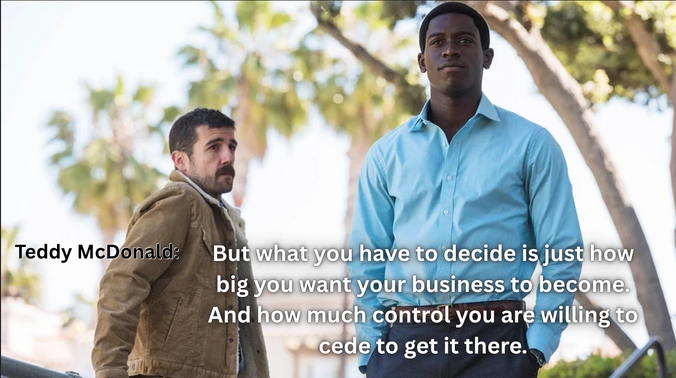
I actually remember first thinking deeply about this while watching the drama series Snowfall. The main character, Franklin Saint, wanted to expand his operation while still having total control over every moving piece. At one point, the CIA agent gives him a blunt reality check: if he wants to go bigger, he has to let go of some control.
That kind of hit me and I haven't been able to unsee it because once you see that pattern, you start spotting it everywhere.
 Snowfall: Franklin and Teddy
Actual quote here
The Economic Blueprint: Hierarchy and Risk
Look at traditional business economics. As a company grows to be really big, it inevitably introduces layers: managers, senior associates, department heads, and executives. Every new tier representing a release of some control. The founder or CEO, for example can no longer approve every email or sit in every meeting.
However, one fundamental thing doesn’t change: the risk.
The higher up the ladder you sit, the greater your ultimate responsibility and exposure to risk. So while operational control is continuously delegated downward, the overall accountability stays right at the top.
As it turns out, the pattern of this economic reality maps surprisingly well to how our relationship with software and AI has evolved.
The Shift to Agentic AI
If you look at the progression of developer tools and modern AI over the past few years, we’ve been basically recreating organizational heirarchies:
- The Solo Era: You wrote every line ( ...yes code copied from Stack Overflow counts too :) ) and held full control over every execution. You bore all of the risk, but you also made 100% of even the micro-decisions.
- The Assistant Era (Copilot / Chat LLMs): We relinquished a small slice of control. We let AI generate functions or suggest fixes, while we manually approved and executed the output. We still called the shots, and we still carried the full blame for bugs.
- The Agentic Era: Now, we’re deploying systems that make autonomous decisions, coordinate sub-tasks, call external tools, and return with completed outputs.
 Evolution of developer tools
I mean, look at what’s happening here: we are building a middle-management layer out of software.
Releasing step-by-step control so we can focus on high-level direction. Not that that is a bad thing, but the relationship between human and computer is shifting from that of an engineer with a tool to that of an executive managing a team.
And as in economics, while the agent handles the intermediate blockers and troubleshooting, the ultimate risk still lands on our desk. If an agentic workflow pushes broken logic to production or misinterprets data, the end-user doesn't blame the model, nope, we get all the smoke.
What History Tells Us Comes Next
To me, this highlights something wild: human problems and their eventual solutions tend to repeat themselves across even completely different domains.
Economics solved the problem of human scale centuries ago through hierarchy and delegation. Today, software engineering is arriving at the exact same design choices as we give AI more and more autonomy.
So, where does this leave us?
If AI is truly following the trajectory of organizational growth, the next bottlenecks won’t just be about context window sizes or raw model intelligence. They will be about governance, auditing, and alignment. Kind of like how corporations had to invent internal controls, compliance departments, and quality checks to manage human delegation, our next challenge will be building reliable safeguards around autonomous AI.
We wanted to automate more and use AI to scale our leverage, but we're learning the same lesson every expanding enterprise eventually learns: Execution of a task can be delegated, but you really can't delegate responsibility.
Discussion (0)
No comments yet. Start the discussion!